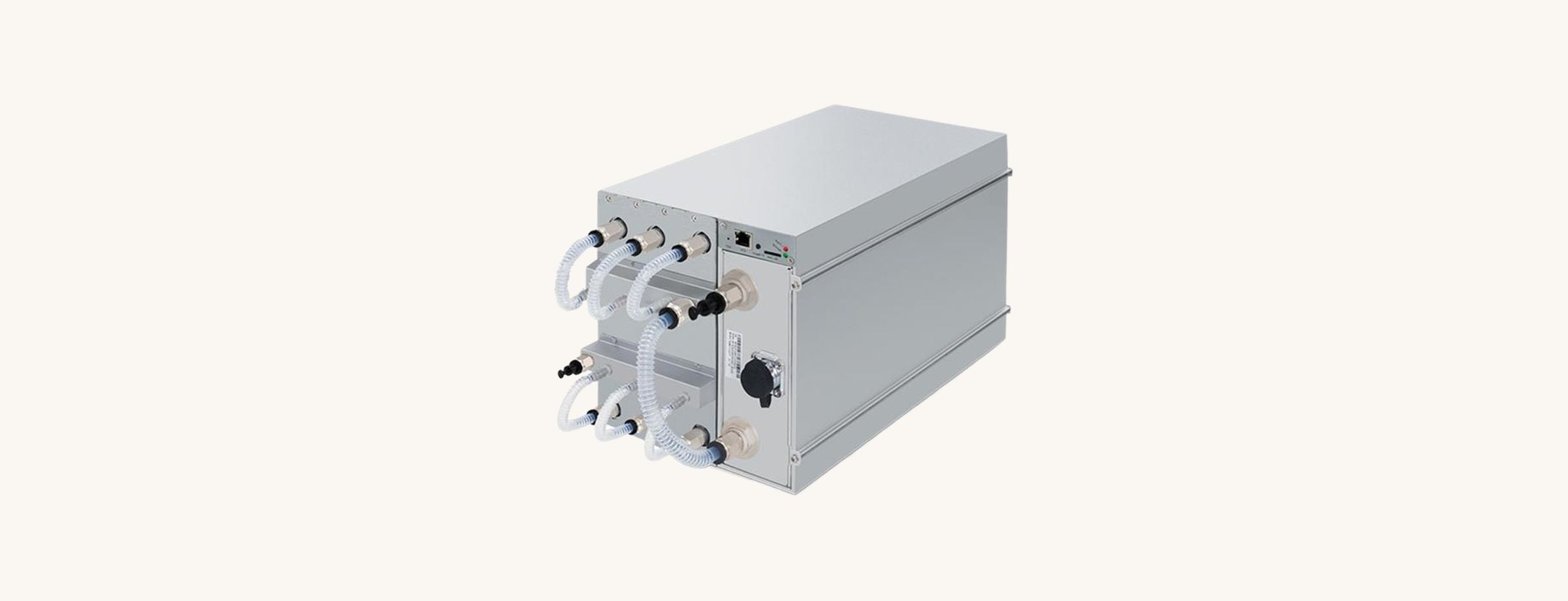
Start with the number nobody prints on the box: the ambient temperature at which the machine holds its rated hash rate. Air-cooled units are specified to 40 °C, and most of them mean it. Above that, firmware throttles, fans spend more watts, and the efficiency you paid for drifts by one to two J/TH. Hydro units are indifferent to air temperature and sensitive to water: inlet above 45 °C and the same throttling logic applies, only now the fix is a bigger dry cooler rather than a fan curve.
That single difference is why the comparison cannot be made from a spec sheet. One machine is limited by the weather, the other by a system you have to build, staff and maintain.
The three costs that decide it
Pump and dry-cooler load is the first. Budget three to five per cent of the miner load for circulation on a well-designed loop, more if the coolers sit on a roof with no shade. That parasitic draw is real power you buy and never hash with, and it does not appear anywhere in the J/TH figure on the box.
Second is water treatment. An untreated loop scales, scaling costs flow, and lost flow costs hash rate long before anything fails visibly. The chemistry is not exotic — filtration, corrosion inhibitor, a quarterly test — but it is a recurring task with a named owner, and sites that skip it discover the cost eighteen months later in the form of derated boards.
Third is competence. A hydro hall needs somebody who reads pressure, not just amperage. If the person on site is an electrician who visits twice a month, a loop is a liability rather than an asset.
If nobody on site owns the water, buy air. The efficiency gap is smaller than the downtime gap.
A worked 2 MW comparison
The table below is what we hand buyers for a 2 MW build in a Gulf climate. It assumes $0.055/kWh, a 45 °C design day, and freight to a regional port. The hydro column carries its share of the loop and cooler capex; the air column carries the derate we expect between June and September.
| 2 MW build | Air, S21 XP | Hydro, S21 |
|---|---|---|
| Units required | 549 | 373 |
| Rated efficiency | 13.5 J/TH | 16.0 J/TH |
| Summer derate, expected | 6–9% | 0–2% |
| Cooling parasitic load | included | +4% |
| Infrastructure capex | $310k | $540k |
| Commissioning window | 3 weeks | 6–7 weeks |
Two things fall out of it. The air column loses hash rate exactly when electricity is often most expensive, and the hydro column spends its advantage on capex and on three extra weeks before the first satoshi arrives. Which of those hurts more depends on your cost of capital, not on the machines.
What we recommend, and when
Under 1 MW, or on a leased site, air almost always wins: it ships faster, it forgives operator turnover, and resale is liquid. Above 3 MW with owned power and a maintenance team, hydro earns its capex back through density and quieter operation, particularly where noise limits are enforced. Between those poles, the decision is rarely about the machines; it is about who will be on site in month nine.
There is a third answer worth naming. Mixed halls work. A hydro block for the base load and an air block that can be powered down on the hottest afternoons gives you density where it pays and flexibility where the grid is unfriendly. It costs a second set of spares, which is the price of the option.
Whichever column you choose, ask the supplier for the derate assumption in writing. A quotation that states rated hash rate without stating design ambient is a quotation for a laboratory, not for your building.